
Cold ironing—also known as Alternative Maritime Power (AMP), Shore Power, Onshore Power Supply (OPS), Shore-Side Electricity (SSE), or High Voltage Shore Connection (HVSC)—is the process of supplying shore-based electrical power to a vessel at berth while its main and auxiliary engines are turned off.
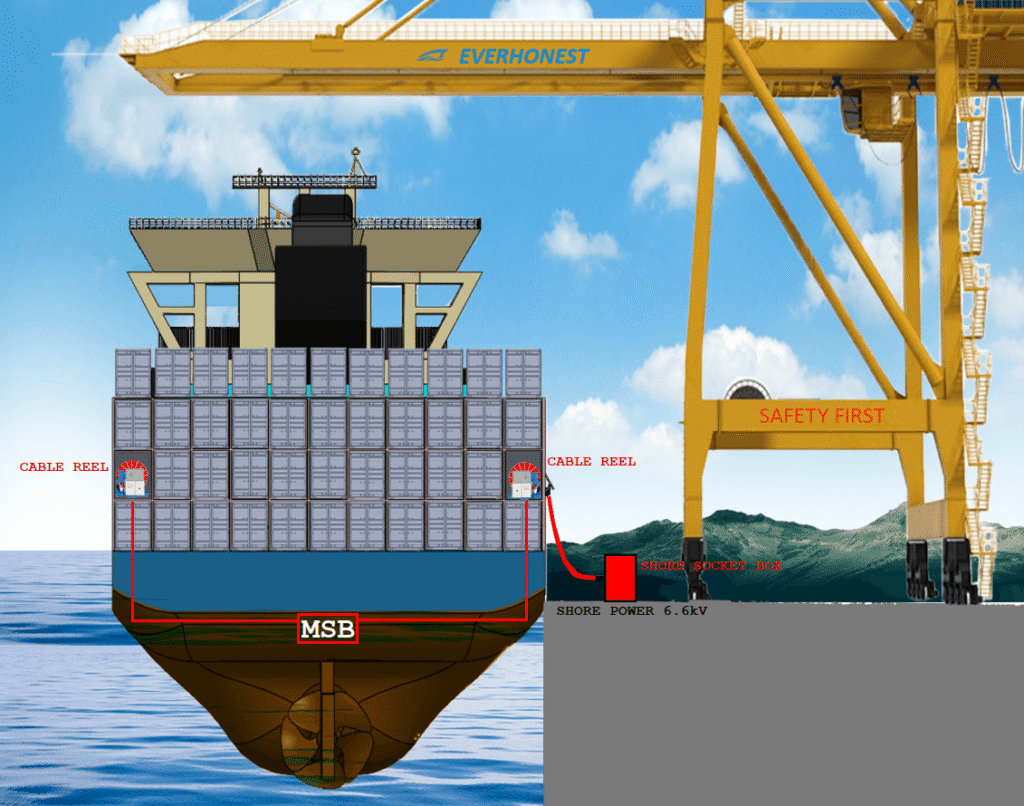
By connecting to the local power grid, ships can continue to operate essential onboard systems—including HVAC, refrigeration, lighting, cargo handling equipment, and crew accommodations—without burning a single liter of diesel fuel.
The term ‘cold ironing’ dates back to the era of coal-fired vessels: when a ship docked and no longer needed to feed its iron engines, those engines would cool completely, going ‘cold.’ Today, the concept is more relevant than ever, sitting at the heart of the maritime industry’s transition to net-zero emissions.
| Key Terminology of Cold Ironing |
|---|
| Key Terminology at a Glance Cold Ironing | AMP (Alternative Maritime Power) | Shore Power | OPS (Onshore Power Supply) | SSE (Shore-Side Electricity) | HVSC (High Voltage Shore Connection)—all refer to the same fundamental technology: connecting a berthed ship to shore-side electricity. |
How Does a Cold Ironing / AMP System Work?
The cold ironing process, while sophisticated in engineering, follows a clear operational sequence. Upon docking, the vessel connects to an onshore power grid via a dedicated AMP shore connection cable system. The system then synchronizes voltage, frequency, and phase between the ship’s onboard power distribution network and the shore supply.
Once the match is confirmed and verified safe, the vessel’s diesel generators are shut down and all electrical load is transferred to shore power. The entire sequence is managed through automated switching and real-time monitoring systems.
Disconnection follows the reverse procedure: the ship’s generators are started, synchronized with shore power, and loaded, and only then is the AMP connection opened. This ensures a seamless, safe transition with no interruption to onboard critical systems.
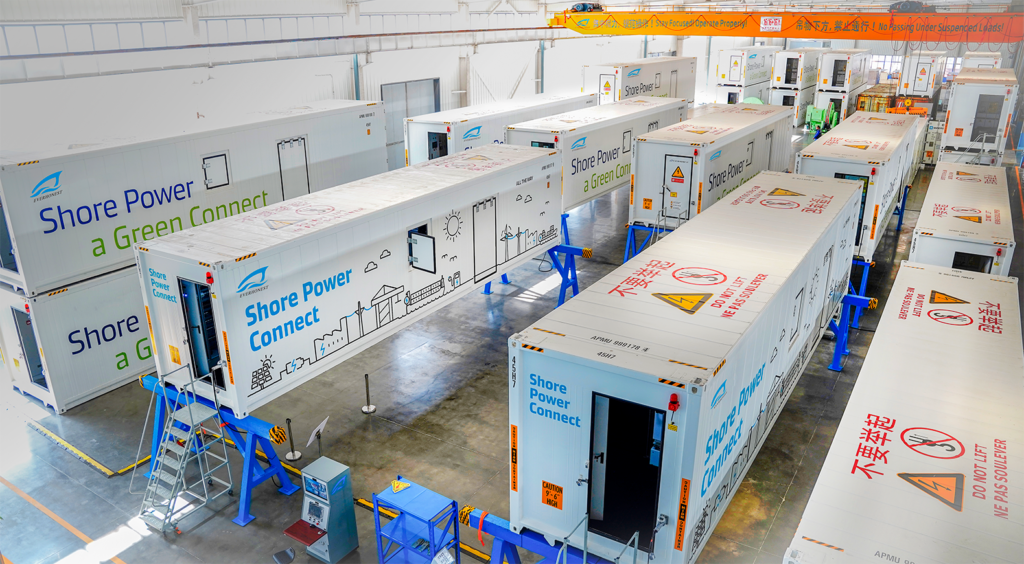
Core Components of an AMP / Shore Power System
• Medium or High Voltage Shore Connection (HVSC) unit—receives and conditions grid power
• Shore power transformer—adapts voltage and frequency to the vessel’s specifications
• Frequency converter—bridges 50 Hz / 60 Hz grid differences common across global ports
• LV/HV control switchboard—manages switching, protection, and interlocking
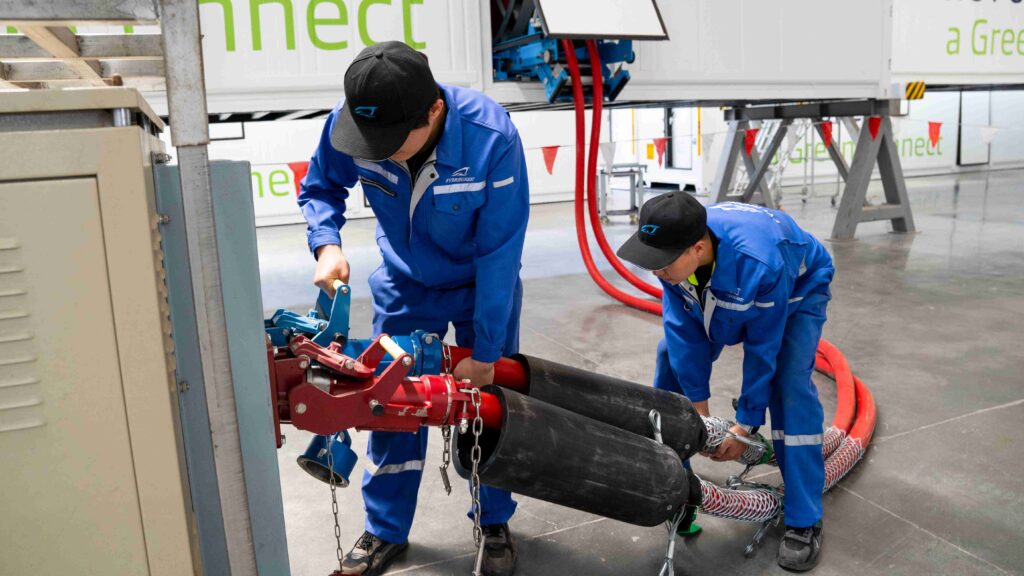
• AMP cable reel system—handles the high-voltage flexible cables that physically connect ship to shore
• Ship-side inlet box and plug/socket connector—the standardized interface on the vessel
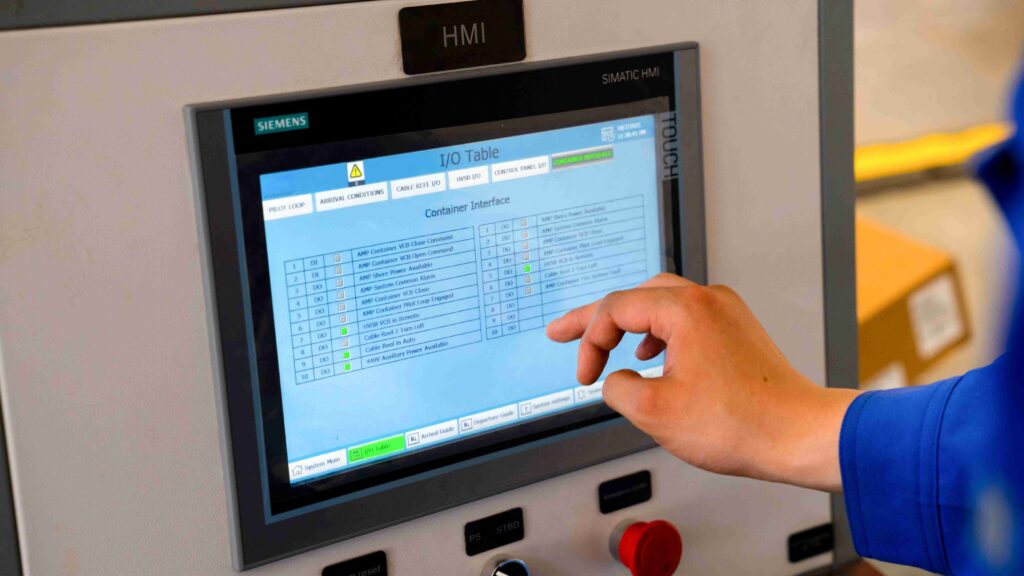
• Real-time monitoring and SCADA interface—provides data logging, alerts, and remote oversight
Key Benefits of Cold Ironing and Shore Power Systems
1. Dramatic Reduction in Emissions
When ships run their auxiliary diesel engines at berth, they generate significant quantities of sulphur oxides (SOx), nitrogen oxides (NOx), carbon dioxide (CO₂), and particulate matter (PM)—directly impacting the air quality of surrounding port communities. Cold iron eliminates these at-berth emissions entirely by replacing diesel generation with cleaner shore-side electricity. Studies indicate that shipping accounts for approximately 15% of global NOx emissions and 8% of global SOx emissions. Shore power directly addresses these hotspot pollutants at their source.
2. Improved EEXI and CII Ratings
AMP connectivity directly supports a vessel’s Energy Efficiency Existing Ship Index (EEXI) and Carbon Intensity Indicator (CII) ratings—two critical IMO metrics that determine a ship’s regulatory compliance and operational efficiency. By eliminating fuel consumption during port stays, cold iron reduces the carbon intensity attributed to the vessel, supporting better CII scores and helping operators avoid financial penalties and rating downgrades under IMO MARPOL Annex VI.
3. Significant Fuel Cost Savings
Running auxiliary diesel generators in port is expensive. Shore-side electricity, particularly where renewable energy tariffs are available, can be markedly more cost-effective. The savings extend beyond fuel: AMP operation also reduces engine running hours, extending auxiliary generator service life, reducing maintenance costs, and minimizing unplanned downtime.
4. Reduced Noise and Vibration Pollution
Diesel engines running at berth generate constant noise and vibration—affecting both crew welfare and the surrounding port community. Cold iron eliminates this entirely. For container vessels and bulk carriers in urban areas, this is a significant quality-of-life benefit.
5. ESG and Sustainability Performance
As regulatory, investor, and customer pressure on Environmental, Social, and Governance (ESG) performance intensifies, shipping companies that can demonstrate zero-emission at-berth operations strengthen their brand, attract sustainability-focused cargo customers, and improve access to green financing instruments.
Regulatory Landscape: Why AMP Is No Longer Optional
The global regulatory environment is now decisively moving towards mandatory shore power adoption, creating urgent timelines for both port operators and shipowners.
IMO MARPOL Annex VI
The International Maritime Organization’s MARPOL Annex VI regulates ship emissions worldwide. AMP systems support direct compliance by eliminating at-berth fuel combustion, addressing SOx, NOx, and GHG obligations. The IMO’s Sub-Committee on Ship Systems and Equipment (SSE) has been actively developing global guidelines for the safe operation of shore-side power supply to ships.
IMO 2050 Net-Zero GHG Strategy
Marine decarbonization—the shipping industry’s critical transition to net-zero greenhouse gas emissions by 2050—is driven by IMO regulations that now carry legally binding force under MARPOL. Cold iron is recognized as one of the most immediately deployable tools available to reduce the GHG intensity of port operations at scale.
EU FuelEU Maritime Regulation (2023/1805)
In force from 1 January 2025, the EU FuelEU Maritime Regulation is a landmark piece of legislation. It mandates that container ships and passenger vessels above 5,000 GT calling at EU Trans-European Transport Network (TEN-T) ports must connect to Onshore Power Supply (OPS) or use equivalent zero-emission technology from 1 January 2030. This requirement extends to all EU ports equipped with OPS from 1 January 2035. Non-compliance carries penalties of €1.50 per unused kilowatt-hour.
| OPS Mandate Timeline |
|---|
| 2025: Regulation in force—GHG intensity reporting begins for all ships >5,000 GT at EU ports. 2030: Container & passenger ships must use OPS at TEN-T core network ports. 2035: The mandate extends to all EU ports equipped with OPS. Penalty for non-compliance: €1.50 per unused kWh. |
California CARB Shore Power Rules
California’s Air Resources Board (CARB) Shore Power Regulation—among the world’s first mandatory shore power rules—requires container ships, cruise vessels, reefer ships, auto carriers, and tankers to use grid-based power or approved emission control technology at California ports. The Port of Los Angeles pioneered AMP technology globally, opening the world’s first AMP-equipped container terminal in 2004 and helping develop the international IEC/ISO/IEEE 80005-1 standard.
China and Global Expansion
China, Norway, and a growing number of major port nations have implemented or are rapidly developing OPS requirements and incentives. Major global ports, including Rotterdam, Hamburg, Los Angeles, Shanghai, and Busan, have made substantial infrastructure investments in shore power, driving demand for standardized, certified AMP systems.
Technical Standards: IEC/ISO/IEEE 80005-1-2022 and Related Regulations
Safe and reliable cold iron demands strict adherence to internationally recognized technical standards. The primary framework governing AMP system design, installation, testing, and operation is IEC/ISO/IEEE 80005-1-2022—the global standard for High Voltage Shore Connection (HVSC) systems. This standard ensures voltage compatibility, electrical safety, and operational interoperability between port infrastructure and vessels from different nations and shipyards.
| Standard | Application |
|---|---|
| IEC/ISO/IEEE 80005-1-2022 | High Voltage Shore Connection (HVSC) — design, installation, testing, and operation |
| IEC 62271-200 | AC metal-enclosed switchgear and controlgear for voltages above 1 kV and up to 52 kV |
| IMO MARPOL Annex VI | International regulations for the prevention of air pollution from ships |
| EU Fuel EU 2023/1805 | Mandatory OPS use at EU ports; GHG intensity limits for ships above 5,000 GT |
| CARB Shore Power Rule | California mandatory shore power regulation for container, cruise, reefer, and tanker vessels |
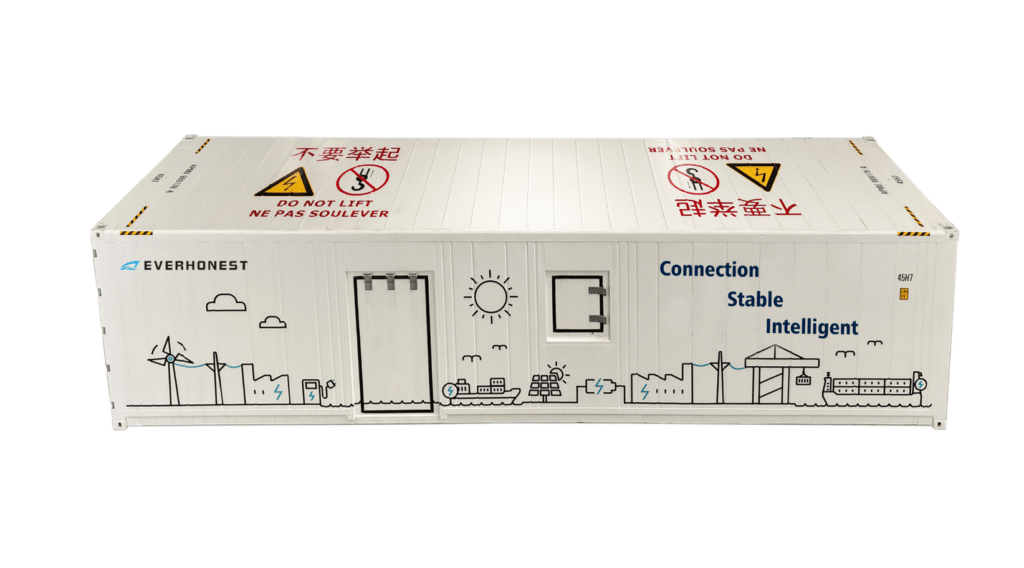
All EVERHONEST AMP systems are designed, manufactured, and tested in full compliance with IEC/ISO/IEEE 80005-1-2022 and IEC 62271-200 and carry AMP class approval certification—making them suitable for both retrofit projects and new-building programs across all vessel types.
EVERHONEST: Your World-Class AMP Technology Provider and Shore Power System Supplier
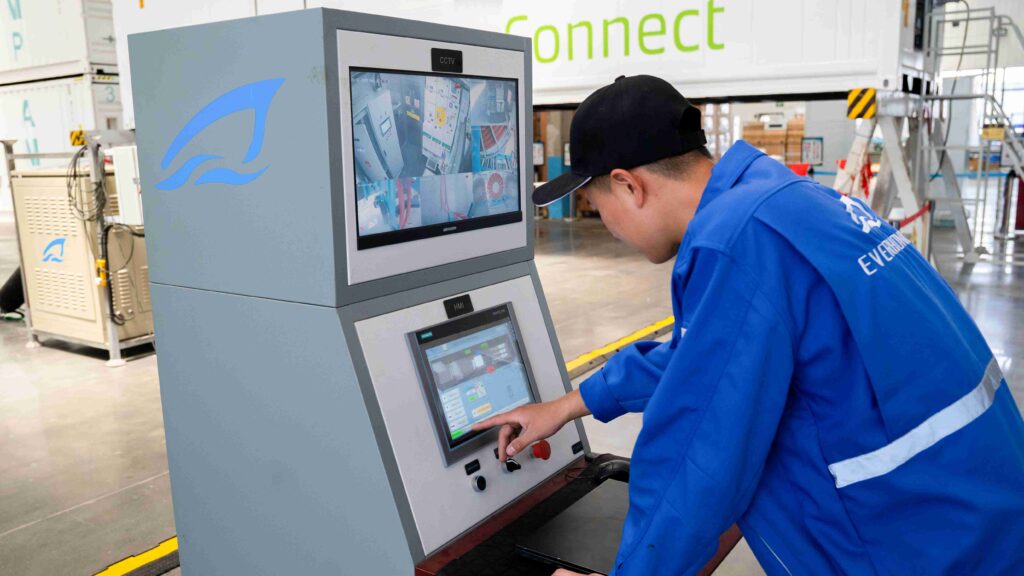
EVERHONEST is a leading Alternative Maritime Power (AMP) Technology Provider and Shore Power System Supplier headquartered in Hong Kong, with a dedicated workshop and manufacturing facility in Qingdao, China. Backed by powerful engineering solution teams, EVERHONEST serves port operators, shipowners, ship management companies, and shipyards across every major maritime region worldwide.
Our Engineering Commitment
Every EVERHONEST AMP system begins with rigorous research and development. Our engineering teams have invested more than 26,280 hours in market research, R&D, and system validation—a commitment that underpins the world-class quality of our containerized AMP systems and shore power solutions. From the structural frame to the smallest fastener, every component meets exacting safety and performance standards.
End-to-End Service: From Feasibility to Full Commissioning
EVERHONEST supports every stage of your shore power project, from initial feasibility studies and customized engineering design through to manufacturing, shipside and portside installation, commissioning, and ongoing technical support. Our process is handled entirely by dedicated in-house colleagues—ensuring quality, accountability, and consistency across every project.
Vessel Types We Serve
• Container Ships
• Cruise Ships
• RoRo (Roll-on/Roll-off) Vessels
• Oil Tankers
• Bulk Carriers
• LNG Carriers
• Ferries and Passenger Vessels
Our AMP System Portfolio
• Medium and High-Voltage Shore Connection (HVSC) units
• Modular and scalable Onshore Power Supply (OPS) solutions
• Plug-and-play Alternative Maritime Power (AMP) interfaces
• Real-time monitoring and automated switching systems
• Mobile kit integrated Container Type AMP Systems
• Retrofit solutions and custom designs for existing port infrastructure
EVERHONEST Container Type AMP System—The Industry Benchmark
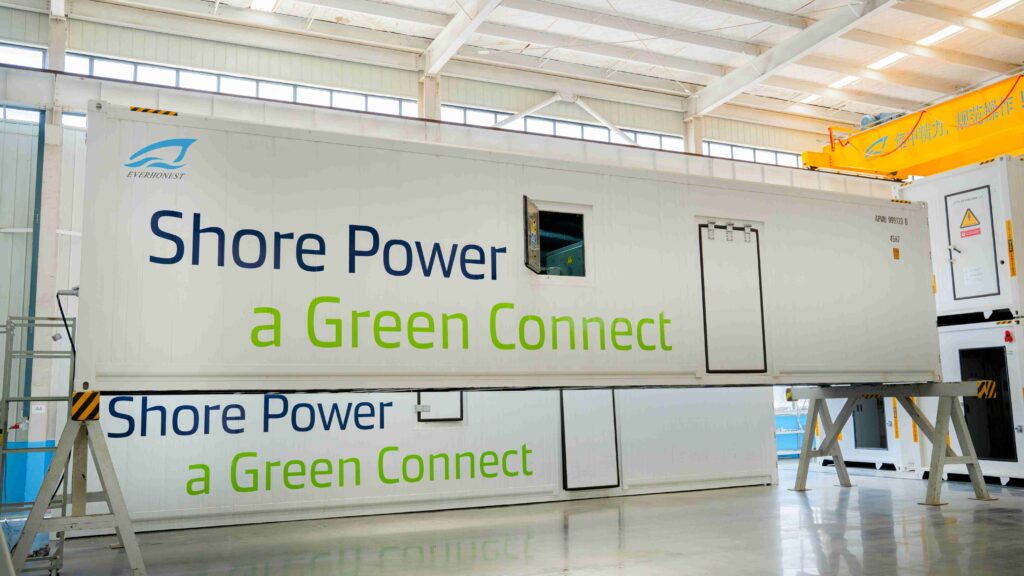
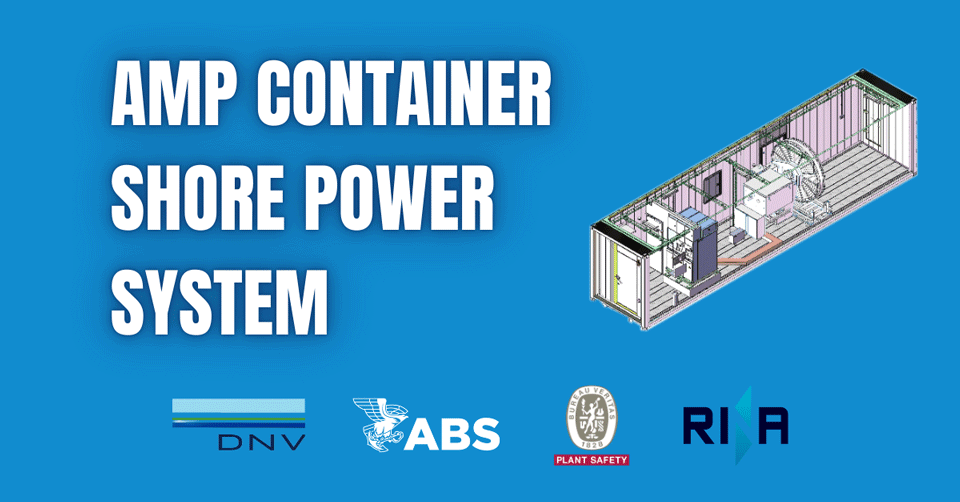
Our flagship product is the EVERHONEST Container Type AMP System—a fully integrated, plug-and-play shore power solution housed in a robust containerized enclosure. Designed for flexibility and rapid deployment, the container AMP system can be positioned dockside at any port globally and connected to both port grid infrastructure and the vessel’s HVSC inlet. It is equally suited to permanent port installations and mobile retrofit applications, making it the preferred choice for port operators seeking future-proof, scalable AMP infrastructure.
System Components and Trusted Supply Partners
| Component | Supplier / Specification |
|---|---|
| AMP Container Enclosure | Stainless Steel Type—CIMC (China International Marine Containers) |
| Cable Reel System | Stemmann-Technik—precision cable management for high-voltage AMP cables |
| High Voltage Switchboard | Schneider Electric—globally certified HV switching and protection |
| LV Control Switchboard | EVERHONEST in-house engineered and manufactured |
| HV/LV Power Cable | Shangshang Cable Group—marine-certified high-voltage flexible cables |
| Fire Alarm System | Marble—marine-grade fire detection and suppression |
Our supply chain partners represent the highest standards in their respective fields. Combined with EVERHONEST’s in-house LV control engineering expertise and our IEC/ISO/IEEE 80005-1-2022 class approval certification, the result is a shore power system that port operators and shipowners can rely on for decades of safe, compliant service.

Global Reach, Local Expertise
EVERHONEST operates from our Hong Kong headquarters and Qingdao manufacturing base, with supply chain and factory partnerships spanning Singapore, Malaysia, Türkiye, Egypt, Germany, South Korea, China, and the United States. Our engineering teams are equipped to deliver AMP and shore power solutions to any port, shipyard, or vessel operating environment worldwide—whether for greenfield port development, terminal upgrades, or individual vessel retrofit programs.
We work directly with shipowners, ship management companies, port developers, terminal operators, and shipyards—providing customized engineering designs, independent feasibility studies, and turnkey project delivery. Our track record covers projects in Asia, Europe, the Middle East, and the Americas.
The Future of Shore Power: AMP as a Cornerstone of Maritime Decarbonization
Cold ironing and AMP systems are not simply a compliance solution—they are a foundational technology in the long-term transformation of the maritime industry. As port grids increasingly integrate renewable energy sources, the emission-reduction benefits of shore power grow exponentially: a vessel drawing power from a wind- or solar-powered grid achieves genuinely zero-emission port operations.
The European Commission has confirmed that shore power plays a ‘key role’ in making shipping greener. Combined with the EU Renewable Energy Directive (RED) target of 42.5% renewable electricity by 2030, OPS-connected vessels in EU ports will benefit from increasingly clean power—and these environmental gains are recognized within the FuelEU Maritime GHG intensity calculations.
Shore power also paves the way for the next generation of zero-emission vessels—battery-electric ships, hydrogen fuel cell vessels, and ammonia-powered carriers—all of which require robust shore-side electrical infrastructure as a prerequisite. Investing in AMP today means investing in the infrastructure backbone of tomorrow’s decarbonized shipping industry.
| Why Act Now? |
|---|
The EU FuelEU Maritime OPS mandate takes effect at TEN-T ports in 2030. Class approval, port grid upgrades, vessel retrofits, and system integration take time. Ports and shipowners who begin AMP planning today will be positioned to comply on time, avoid penalties, and gain competitive advantage in an emissions-regulated market. EVERHONEST is ready to support your journey from feasibility study to full commissioning. |
Why Choose EVERHONEST for Your AMP and Shore Power Project?
• IEC/ISO/IEEE 80005-1-2022 certified AMP systems—class approved and globally compliant
• 26,280+ hours of dedicated R&D and engineering investment
• Full in-house capability: design, manufacturing, installation, commissioning
•Container Type: AMP System for fast, flexible deployment at any port worldwide
• Trusted global supply chain: CIMC, Stemmann-Technik, Schneider, Shangshang Cable
•Customized solutions for all vessel types: container, cruise, RoRo, tanker, LNG, bulk carrier
• Retrofit and new-building expertise—from single vessel to fleet-wide programs
•Headquartered in Singapore with manufacturing in Qingdao, China.